


As populations age worldwide, the longevity economy is becoming one of healthcare’s most important innovation markets. But extending lifespan is only part of the equation. Increasingly, entrepreneurs, investors, and healthcare systems are focused on extending healthspan—helping people live longer with better cognitive, physical, and metabolic health while reducing the burden on families and care systems. This shift is accelerating demand for technologies that enable earlier diagnosis, proactive care, caregiver support, and more personalized interventions.
For Stead Impact Ventures, these trends sit squarely at the intersection of our investment pillars in neurodegenerative disorders, mental health, and metabolic health. Many of the most promising innovations today are converging around AI-enabled diagnostics, digital biomarkers, remote monitoring, and care models designed to help people maintain independence and quality of life as they age—areas where we believe innovation can create meaningful value for patients, providers, and investors alike.

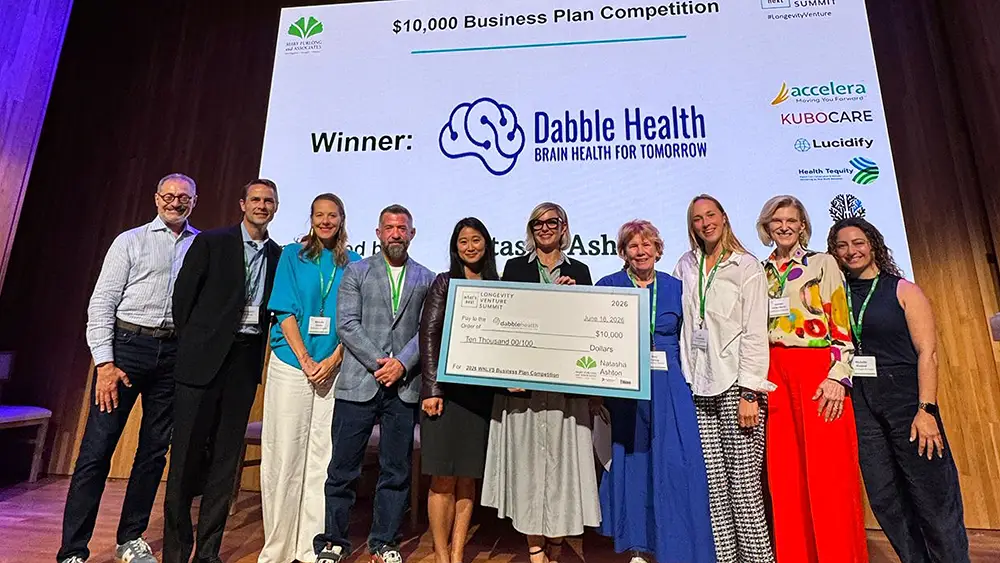
In June, Chief Commercial Officer Aidan Thompson served as a judge for the $10,000 Business Plan Competition at the 23rd Annual What’s Next Longevity Venture Summit, held June 16–18 at UC Berkeley. The Summit, presented by Mary Furlong & Associates, remains a flagship gathering for investors, entrepreneurs, and operators building in the longevity economy.
This year’s competition was the most contested in its history, with nearly double the number of applicants from previous years. Entrants included founders from 24 states and eight countries pitching ideas that spanned the full breadth of where the aging market is heading—including AI-driven health analytics, caregiving innovation, falls detection, cognitive performance and brain health, and solutions addressing mental health and social isolation in older adults.
Aidan judged alongside a distinguished panel that included Amelia Hay (AgeTech Collaborative from AARP), Chris Swenson (Ziegler), Anu Shukla (Botco.ai), Michelle Snyder (McKesson Ventures), and Tiffany Yu (7wire Ventures).
The $10,000 prize went to Brooke Albright of Dabble Health, selected from six finalists. Dabble Health’s Mind Atlas app transforms personal photos from a smartphone’s photo library into daily cognitive check-ins that can help identify early signs of cognitive decline and alert care teams through automated documentation and compliance support.
Reflecting on the competition, Aidan noted that the strongest companies consistently demonstrated three characteristics: a clearly articulated problem, a credible leadership team, and a commercialization strategy grounded in a realistic understanding of the market.
The Summit also honored Shauna Sweeney of Tendercare with the John Hopper Impact Award, recognizing transformative solutions that improve the lives of older adults.
Key Takeaways
- Early detection continues to dominate—AI and digital biomarkers are moving upstream in disease management.
- Caregiving innovation is accelerating as workforce shortages and demographic shifts increase demand.
- Healthspan has become the investment focus—solutions that preserve cognition, independence, and quality of life are attracting growing attention.
- Commercial discipline matters—the strongest founders paired compelling science with realistic go-to-market strategies.
For Stead, events like the Longevity Venture Summit provide an important window into where entrepreneurs and investors are directing their attention. This year’s competition reinforced several themes we continue to see across healthcare innovation: growing investment in earlier detection of cognitive decline, greater support for caregivers, increasing use of AI to enable proactive care, and stronger recognition that improving healthspan—not simply lifespan—will define the next generation of healthcare innovation. These trends closely align with our mission to invest in innovations that improve health and wellbeing while bending the curve in neurodegenerative disorders, mental health, and metabolic health.