


Our previous article focused on health and wellness, and this final report focuses on growth, brand, and marketing. Key observations:
- Discipline in scaling and storytelling is critical. The best companies use data to time growth and craft pitches and narratives that create connection—not just convey information.
- AI is reshaping discovery and compressing decisions. Your brand must be clear, credible, and understandable to both humans and AI systems—often in a single interaction.
- Trust and differentiation are the new growth drivers. In a world of AI-generated sameness, authentic storytelling, strong positioning, and human creativity set companies apart.
Session Overviews

The Science of Scaling: Using Data to Decide When – and How Fast – to Scale
Mark Roberge (Managing Director of Stage 2 Capital, Founding CRO at HubSpot, Senior Lecturer at Harvard Business School, and author of the newly released The Science of Scaling) presented his framework for when to scale, and how fast. This is easily one of the most consequential decisions a startup faces.
The core argument is that most companies scale on instinct or investor pressure rather than data, and that this is the single biggest driver of failed revenue acceleration. His framework introduces a rigorous, stage-based model built around a quantifiable leading indicator of customer retention, giving founders a defensible, data-driven signal for when they’ve truly earned the right to scale.
This is directly relevant for us at Stead Impact Ventures and all of our portfolio companies. Whether a company is still validating product-market fit or building toward repeatable GTM motion, Roberge’s framework raises the right questions at the right time to keep teams from scaling before the foundation is ready, which he views as the most common and costly mistake in early-stage growth. We encourage everyone to watch the full video of this one.

Creative Pitching: Nerve Bundler to Board Room Wrecking Ball
Natalia Talkowska (Founder & CEO of Natalka Design, 6x TEDx Speaker) led one of the most engaging rooms at SXSW in a session on creative pitching that was equal parts neuroscience and craft.
The session was built around Jon Burkhart’s 4C Connection Flywheel as a framework for structuring a pitch that doesn’t just inform but moves people.
- Curiosity: Interrogate identity, beliefs, and desires. If you don’t understand how your audience sees themselves, your message drifts. Open with a question that creates engagement before you’ve made a single claim.
- Conviction: State your sharp, defensible point of view in one brave sentence – the t-shirt line. Clear, memorable, and unapologetic.
- Conversation: Create genuine two-way exchange. The pitch becomes a rally, not a monologue.
- Community: The rallying cry. Turn your audience into advocates. The goal isn’t applause on Day 1, it’s whether they’re still talking about you on Day 2 and beyond.
Amazingly, the Community stage was illustrated with “The Wave” at the Stead Family Children’s Hospital at the University of Iowa as the benchmark for what community looks like at its best. Aidan had three relevant sessions scheduled that hour and coincidentally chose this one only to hear the Stead name used as the gold standard for human connection.
The session also made the case that charisma isn’t one thing. Authoritative, Visionary, Relational, and Disruptive were highlighted as distinct styles that read differently in a room. The most effective pitchers know which type is authentically theirs and lean into it rather than mimicking someone else’s.
“Your pitch isn’t just your deck. It’s the room you create when you walk in.”
Panelists: Allister Hercus, founder, Stoop Studios; Grace Keo, CMO, Snap; Nataliya Kosmyna, Research Scientist, MIT; Ben Nilsen, SVP Head of Brand Experience, BBDO New York.
This session explored how AI is rapidly becoming the default interface for how people search, evaluate, and make decisions—fundamentally reshaping consumer behavior and brand interaction.
A central tension emerged: while AI drives efficiency and scale, it also trends toward homogenization. As AI-generated content becomes more prevalent, distinctly human qualities—creativity, taste, and originality—are becoming more valuable differentiators. AI excels at research, testing, and iteration, but still lacks the ability to surprise, delight, or express nuanced judgment.
At the same time, discovery is shifting toward a “no-click” environment, where AI systems synthesize and deliver answers directly—often without users visiting a brand’s website. This compresses the decision journey and elevates the importance of how a brand is interpreted by AI systems, not just humans.
Panelists emphasized the need to rethink digital presence through an “AI-first” lens:
- Brands should actively audit how large language models interpret and represent them
- Websites should be structured to be easily understood and surfaced by AI agents
- Structured content and underlying code are becoming as important as front-end design
- In some cases, separating human-facing digital experiences from AI-optimized content may be necessary
AI is not just a tool—it is becoming an intermediary layer between brands and consumers. Success will depend on optimizing for both human perception and machine interpretation, while doubling down on distinctly human creativity as a competitive edge.
Your Brand Has Multiple Personalities. Is that a Problem?
Speaker: Lillian Marsh, Founder, TinyWins
This session explored a critical tension in modern brand building: how to remain consistent while adapting across platforms with fundamentally different behaviors and expectations.
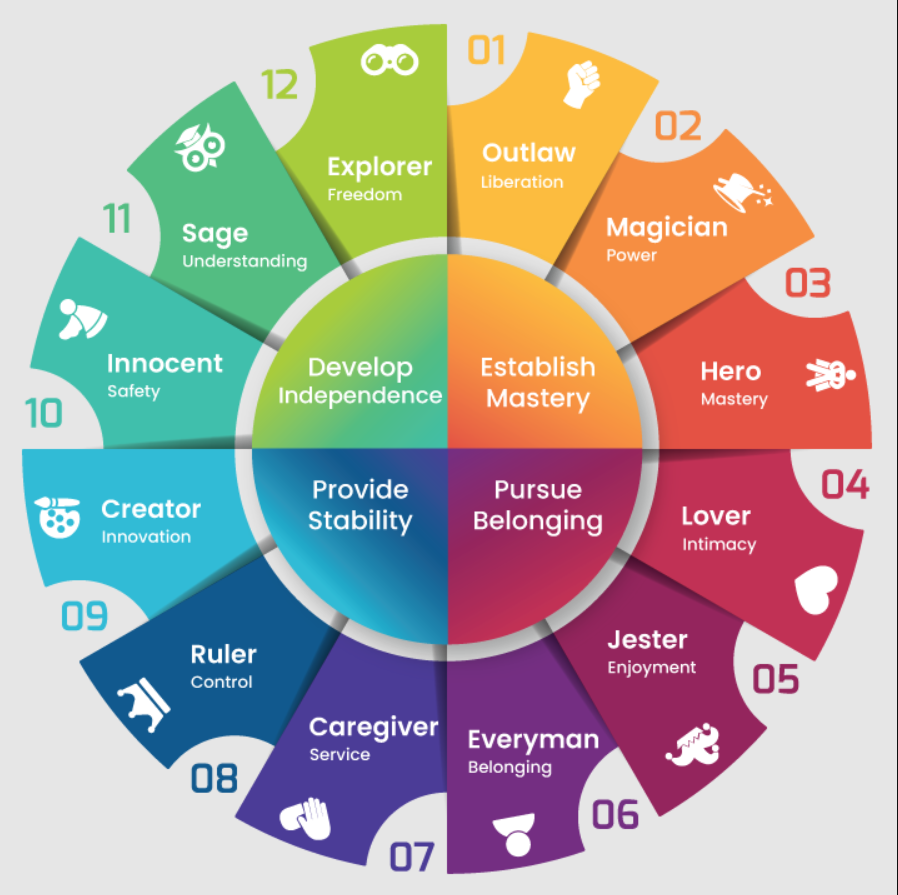
Grounded in archetype theory (rooted in Jungian psychology), the session reinforced that the most effective brands anchor in a clear, recognizable “character” that audiences can quickly understand. Examples illustrated how leading brands consistently embody archetypes—e.g., Mercedes as the Ruler, BMW as the Hero, Jeep as the Explorer—creating intuitive, narrative-based positioning rather than relying on functional messaging.
At the same time, brands today are expected to “code-switch” across platforms (e.g., TikTok, LinkedIn, Instagram), each with its own tone and norms. Effective brands adapt expression, not identity: Inconsistent brands fracture trust by behaving like entirely different entities. The risk is “brand schizophrenia”—where attempts to optimize for platform trends dilute core identity. Strong brands maintain a consistent archetype and set of values, while flexing tone and format by channel. Clarity of identity enables adaptability—without it, adaptation becomes fragmentation.
For our portfolio, different company types naturally lend themselves to different archetypes:
Biotech / Therapeutics (Spinogenix)
→ Sage (scientific authority) + Hero (solving high-stakes problems)
Implication: Lead with credibility and breakthrough potential, while maintaining humility and rigor.
Diagnostics / Early Detection (Amydis, ALZpath)
→ Sage + Caregiver
Implication: Balance scientific precision with patient-centered impact—clarity and trust are paramount.
Digital Health / Platforms / AI-enabled tools (elbi, MedWatch Technologies)
→ Magician (transformation through technology) + Everyman (accessible, usable)
Implication: Translate complex capabilities into simple, empowering experiences.
Healthcare Services / Access / Supply Chain (Cato)
→ Caregiver + Everyman
Implication: Emphasize reliability, trust, and real-world impact on patients and providers.
Workplace Health / Prevention / Human Performance (Inseer)
→ Caregiver + Sage
Implication: Combine data-driven insight with a human-centered approach – helping organizations proactively protect and improve health outcomes while building trust with both employers and employees.